


Ghid pentru ajustările sezoniere în Google Ads
.png)
Seasonality adjustments in Google Ads allow advertisers to proactively signal to Smart Bidding when they expect a short-term change in conversion rates. These adjustments are particularly helpful during brief promotional moments where performance behaves very differently from usual. They are common during peak shopping periods, but just as relevant for flash sales, shipping-deadline rushes, or other time-limited offers.
This guide covers what seasonality adjustments are and when to use them. For setup instructions, check out this Google Help Guide.
What seasonality adjustments are
Seasonality adjustments are designed for short, unusual events where conversion rates change faster than Smart Bidding can typically learn. Google’s bidding algorithms are good at recognising ongoing seasonal patterns, but they aren’t designed to instantly react when performance spikes or drops within just a few days. Think of a 48-hour flash sale, a one-day sitewide discount, or the final shipping deadline before Christmas. Customer behaviour shifts quickly, and Smart Bidding may not have enough time or data to understand what’s happening.
A seasonality adjustment acts as a temporary signal that, during a defined time window, your conversion rate will be higher or lower than usual. With this extra context, Smart Bidding can adjust bids more accurately throughout the event instead of waiting to learn the sudden change on its own.
Why conversion value per click is the most important metric
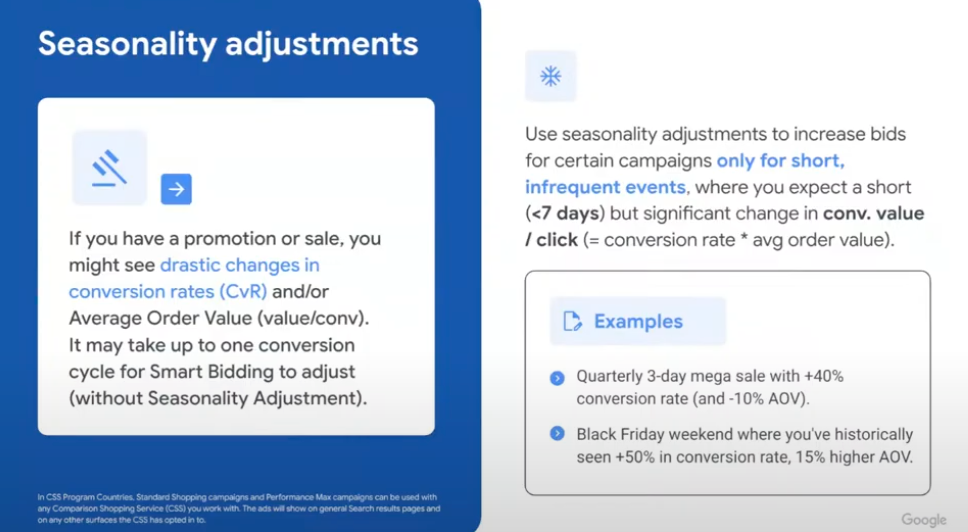
A simple way to evaluate whether you need a seasonality adjustment is to look at conversion value per click.
Conversion value per click = conversion rate × average order value (AOV)
- Conversion rate: the percentage of people who end up buying
- Average order value (AOV): how much they spend when they purchase
When either metric changes, the value of each click changes too. For example:
- A strong sale may boost conversion rate significantly
- A discount may lower AOV even if conversion rate rises
- Black Friday often increases both
Seasonality adjustments are most helpful when this shift in value per click is large and happens quickly, not gradually.
When seasonality adjustments make sense
When using conversion value-based Smart Bidding
Seasonality adjustments work only for campaigns that use value-based Smart Bidding (Performance Max, Standard Shopping, or strategies like Maximize Conversion Value or Target ROAS). They won’t affect campaigns focused solely on clicks or impressions.
Short-term spikes in demand
During a three-day flash sale, your conversion rate might jump while AOV drops slightly. Even if shoppers spend a bit less per order, the higher number of conversions makes each click more valuable. Because this shift happens quickly, Smart Bidding may not adjust in time.
Major retail events like Black Friday or Cyber Monday follow the same pattern. Purchase intent rises sharply for a limited number of days, and giving Smart Bidding a temporary performance signal helps it bid accurately from the start rather than catching up mid-event.
Short-term drops in demand
Seasonality adjustments can also support Smart Bidding during brief slowdowns. For instance, right after the final Christmas shipping deadline, shoppers often pause buying for a few days. A negative seasonality adjustment tells Smart Bidding to lower bids during this slower period so you don’t overspend.
How to decide whether you need a seasonality adjustment
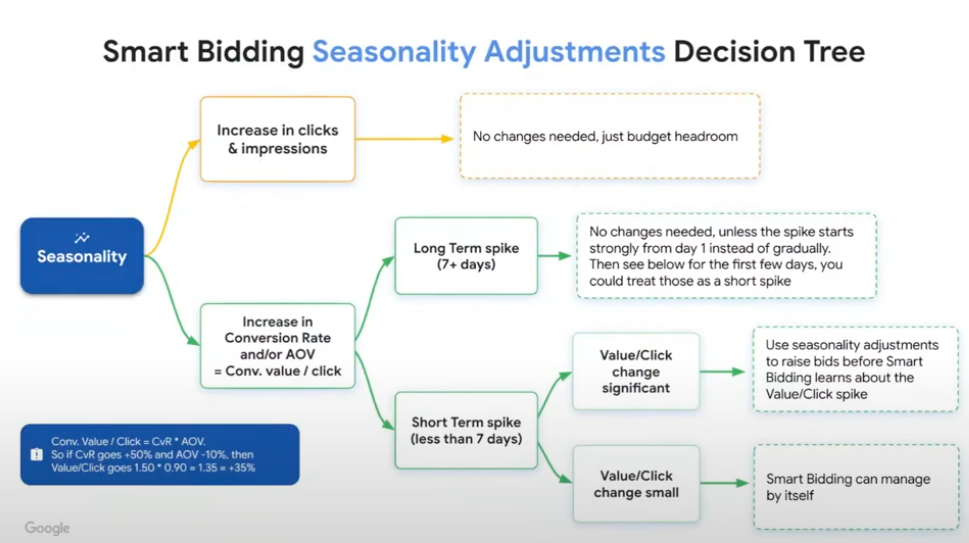
To determine whether an adjustment is appropriate, we created a decision framework that you can populate with your performance metrics. You can request it here. Based on Google’s best practices, it will indicate whether a seasonality adjustment is recommended or if Smart Bidding is likely to handle the fluctuation on its own.
.png)
Your final decision should consider the following questions:
1. Is the change driven by conversion behaviour, not just traffic?
If you're only expecting more clicks due to higher search volume, Smart Bidding doesn’t need a seasonality adjustment. It only needs enough budget.
An adjustment is relevant only if conversion rate, AOV, or both are expected to shift meaningfully.
2. Will the change last fewer than seven days?
Seasonality adjustments are designed for short bursts, not long stretches.
Smart Bidding usually adapts on its own if the change lasts longer than 7 days.
Short events, like 24-hour sales, weekend promotions, or brief dips after shipping cut-offs, are ideal use cases.
3. Is the impact significant?
If the change is minor, Smart Bidding can handle it.
If the change is substantial and happens quickly, a seasonality adjustment can improve bidding immediately.
Getting the most out of seasonality adjustments
Seasonality adjustments can be valuable, but they’re also easy to misuse. Advertisers often apply them to long-term patterns Smart Bidding already understands, use them for very small changes, guess the expected impact without data, or forget to remove them once the event ends. These mistakes can confuse the algorithm and hurt performance.
The best time to use a seasonality adjustment is during a short, unique event that causes a sharp and temporary change in conversion value. In these cases, Smart Bidding may not react quickly enough on its own. Before applying an adjustment, make sure the event is brief, the impact is meaningful, and your data is reliable. If those factors aren’t in place, it’s usually better to let Smart Bidding handle things naturally.
Articolele și studiile noastre de caz
Ghid pentru ajustările sezoniere în Google Ads
.png)
Cele mai bune practici pentru comerțul electronic în 2026
