


Migliori pratiche per l'e-commerce nel 2026
.png)
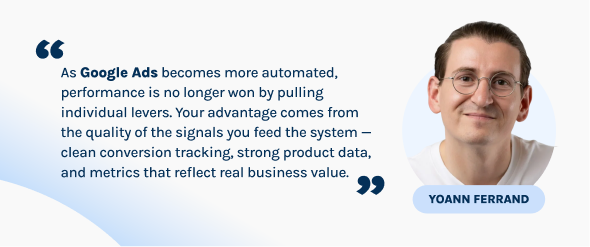
As Google Ads becomes more automated and multi-surface by default, PPC success in 2026 depends less on manual optimization and more on the quality of the signals advertisers provide. Campaign management is increasingly real-time and algorithm-driven, which means your competitive advantage comes from clean conversion tracking, high-quality product feeds, and strong performance data.
This article highlights the key PPC priorities for 2026, based on insights shared by Yoann Ferrand (PPC Specialist) and Jyll Saskin Gales (Google Ads Coach) during Producthero’s latest webinar. You can watch the full session on demand here.
The 2026 PPC landscape: ads, guardrails, signals
Yoann Ferrand described the shift in PPC as a move across three core areas: how ads show up, how control works, and what actually drives performance.
Ads are changing (placements & experiences)
Ads are no longer limited to classic search results or standard Shopping placements. They increasingly appear across AI-driven experiences where users search for answers, not just keywords.
What this means in practice
- Keywords alone are no longer enough
- Product data, structured feeds, and content help platforms understand what a product is and when it should appear
- PPC performance now depends on close alignment between PPC, product feeds, SEO, and on-site content
Guardrails are evolving (more, different control)
Automation continues to expand through Performance Max and Demand Gen, but advertisers are not losing control. Instead, control is shifting. Rather than managing every lever manually, advertisers are guiding automation through smarter guardrails: budgets, targets, inventory limits, and customer signals.
Signals matter more than ever (first-party + measurement)
As platforms automate more decisions, performance depends on the quality of the signals they receive. Key priorities include reliable conversion tracking, properly consented data, strong first-party audiences, and signals that reflect business reality (e.g. profit, returns, or customer value) rather than ROAS alone. Measurement is no longer just about reporting results, but about actively educating the platform so it can make better decisions over time.
A practical framework for eCommerce advertisers
Jyll Saskin Gales translated these trends into a clear, practical framework built around three steps: maintain, optimize, and grow.
Step 1: Maintain a strong data foundation (the “3 Cs”)
AI-driven campaigns only work if the underlying data is reliable. Jyll highlighted three fundamentals that every account should regularly review:
C1) Conversion tracking:
Make sure Google Ads can reliably measure purchases (and consider micro-conversions like begin checkout if volume is low).
C2) Consent Mode v2:
Especially relevant for European advertisers. If consent mode isn’t implemented correctly, you’re likely undercounting conversions and starving automation of data.
C3) Customer Match:
First-party customer data remains one of the strongest signals advertisers control. With lower thresholds now in place for many campaign types, customer match is easier to use and more impactful than before.
Step 2: Optimize your product feed (the most underused lever)
For Shopping and Performance Max, your product feed effectively defines both targeting and ads. Jyll called out three attributes to prioritize:
1. Product titles
Titles should match how users search, not just internal or brand naming. If your product name is great on-site but vague in Shopping results, you’re limiting your reach. Example: “Women’s cotton striped t-shirt” performs better than a vague brand name
2. Product type
Use this field to clearly describe what the product is (e.g. shirt, dress, laptop). Don’t cram colour/material/brand into product type — those belong in the title and other relevant fields.
3. Product images
Images often decide the click. Clear, high-quality, and distinctive images are critical in competitive feeds
Step 3: Grow through new formats and channels
Once the basics are set, growth comes from expanding reach in a controlled way. Jyll highlighted three priorities for eCommerce advertisers in 2026.
1. Performance Max
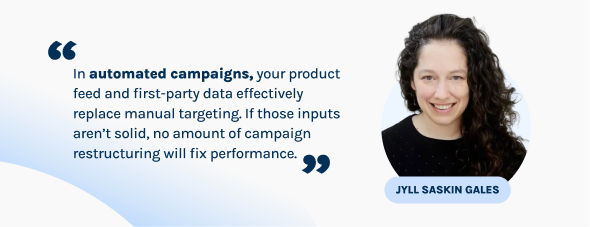
Performance Max is central to Google’s direction. When it underperforms, the issue is usually not the campaign type but the inputs:
- Feed quality
- Conversion tracking
- Creative assets
- Budget and learning time
When fundamentals are strong, PMAX becomes a scalable growth channel.
2. Demand Gen
Demand Gen helps reach users earlier in the journey, similar to paid social.
- Best used for awareness and demand creation
- Start simple (often image-only)
- Don’t expect immediate lower-funnel efficiency
3. YouTube
YouTube is no longer optional for eCommerce.
- High budgets or polished production are not required
- Short, low-production videos can perform well
- In-feed placements are especially effective for discovery and intent capture
Final takeaway
In 2026, PPC performance is shaped less by manual optimization and more by the quality of the inputs behind automation: clean conversion tracking, meaningful value signals, and well-structured product feeds. As Google increasingly automates bidding, targeting, and placements, advertisers are focusing on measurement and data quality that help algorithms optimize toward real business outcomes.
To explore the full discussion (including practical Q&A on budgets, PMAX structure, and control in automated setups) you can watch the complete webinar recording, available here on demand.
I nostri articoli e casi di studio
.png)
Guida agli adeguamenti stagionali in Google Ads
Migliori pratiche per l'e-commerce nel 2026
